Learning
A Practical Look at EIP-7702 and Wallet Delegation
EIP-7702 introduces a powerful new capability to Ethereum wallets, but it also creates a visibility problem that most users are not yet equipped to handle.
To help address this, we built an EIP-7702 Delegation Checker App, a free and open-source web app that lets anyone check whether an Ethereum address has been delegated under EIP-7702, across multiple EVM chains, in one place.
This post explains what EIP-7702 actually does, why delegation visibility matters, and how users and builders can think about wallet safety as account abstraction becomes more common.
Key Takeaways
EIP-7702 represents the next generation of account abstraction, enabling Externally Owned Accounts (EOAs, like MetaMask) to execute with associated smart contract logic via delegation
The EIP-7702 Delegation Checker App is an open-source, frontend-only application that lets users verify EOA delegation status across multiple EVM chains
Delegation is powerful, but visibility is critical for trust and safety
Before the Delegation Checker App was released, users relied on manual explorer checks or custom code
The ecosystem still needs better revocation support across wallets
What Is EIP-7702?
EIP-7702 is often described as the next step after ERC-4337, giving EOAs superpowers.
Until EIP-7702, users had to pick: keep your EOA with a single private key, or migrate to an account abstraction smart wallet such as those built on EIP-4337. That migration typically meant adopting a new wallet address and new infrastructure.
EIP‑7702 removes that fork in the road. It lets an EOA "borrow" a piece of smart contract code, which means an address can be used both as an EOA, as well as a smart wallet.
In practice, this means:
You keep your existing wallet and address
Your EOA can execute programmable contract logic via delegation
You can batch multiple calls
You can enable gas sponsorship
You can enforce custom spending or authorization rules
Delegation and the Visibility Gap
EIP-7702 introduces a key concept called delegation.
Delegation means attaching smart-contract source code to an EOA. When a wallet is delegated:
The EOA becomes associated with smart contract code
That code can execute actions on behalf of the account
The user is trusting the delegate contract to behave correctly
This doesn’t mean EIP-7702 is unsafe, but it is a different permission model than signing a one-time transaction. Delegation is closer to installing software than approving a payment.
The problem we saw was that there was no easy way to check delegation across chains.
Before dedicated tooling existed, you could piece it together by:
Visiting multiple block explorers (if they even show delegation clearly), or
Writing your own code to query many blockchain RPC endpoints and check for code at the address / related signals
These methods, however, were time-consuming for regular users and repetitive work for developers, so we built a tool that we wished existed.
The EIP-7702 Delegation Checker
Enter the EIP-7702 Delegation Checker App, a lightweight web app that answers a simple question across many networks:
“Has this address been delegated, and if so, on which chains, and to what?”
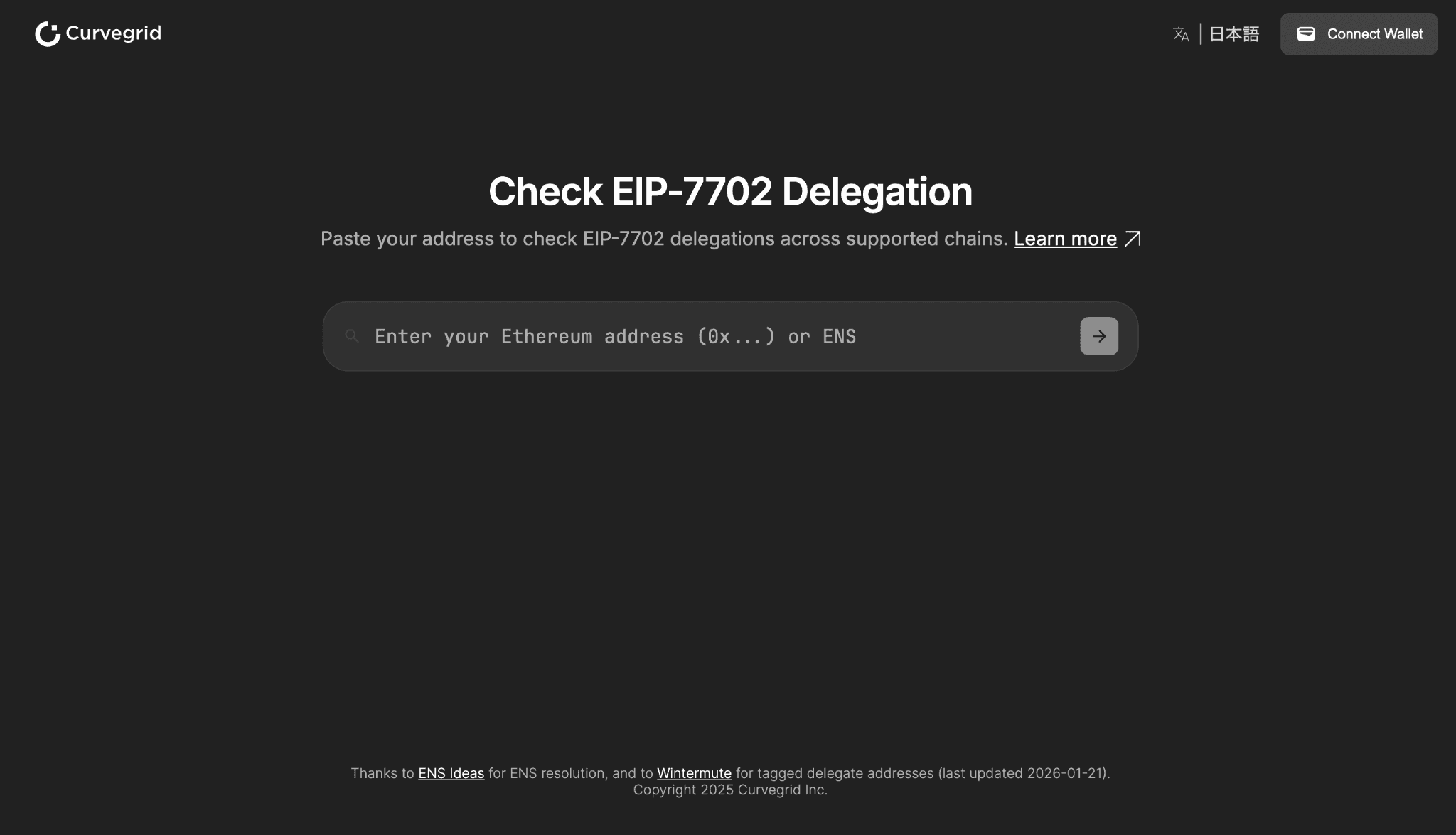
Users paste an address or ENS name, click a button, and immediately see their wallet’s EIP-7702 delegation status across supported EVM chains.
No wallet connection is required.
How the Checker Works
A typical user flow looks like this:
Open the checker
Enter an Ethereum address or ENS name
Click Search
Review results across supported chains:
Not detected = no delegation found
Not supported yet = chain not fully supported
Delegated - provides links to:
The delegate smart wallet contract
The original EOA address
From there, the user may take actionable next steps based on their outcome:
Delegation Status | User Actions |
Expected (e.g., a reputable wallet) | No further action is needed (this is confirmation and gives you peace of mind) |
Unexpected | Revoke (if possible) Move funds defensively if compromise is suspected Investigate the delegate contract address |
What the Checker Is Used For
The checker helps users:
Confirm expected delegations
Identify unexpected or forgotten delegations
Flag delegate contracts that warrant further investigation
Revoke delegations when supported
Gain peace of mind through simple visibility
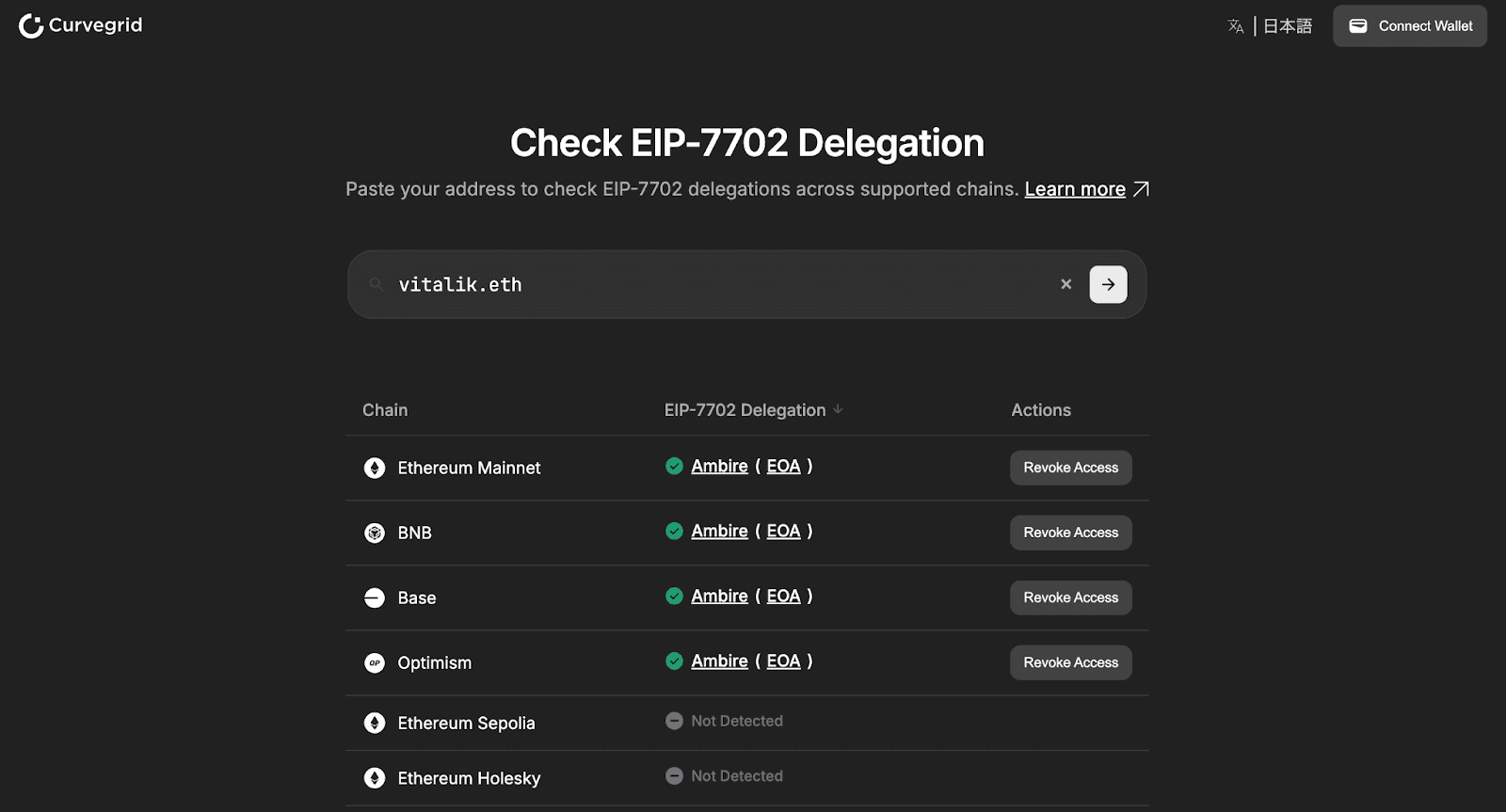
A healthy wallet typically shows no delegation or delegation to a well-known smart wallet implementation. This is an example of a “healthy” wallet with expected delegations:
Delegate Signals and Safety Indicators
The Delegation Checker surfaces visual safety indicators to help users quickly interpret what they are seeing.
Each detected delegation is accompanied by a signal:
✅ Green check mark: The delegate is recognized as a known good implementation (for example, a reputable smart wallet such as Ambire).
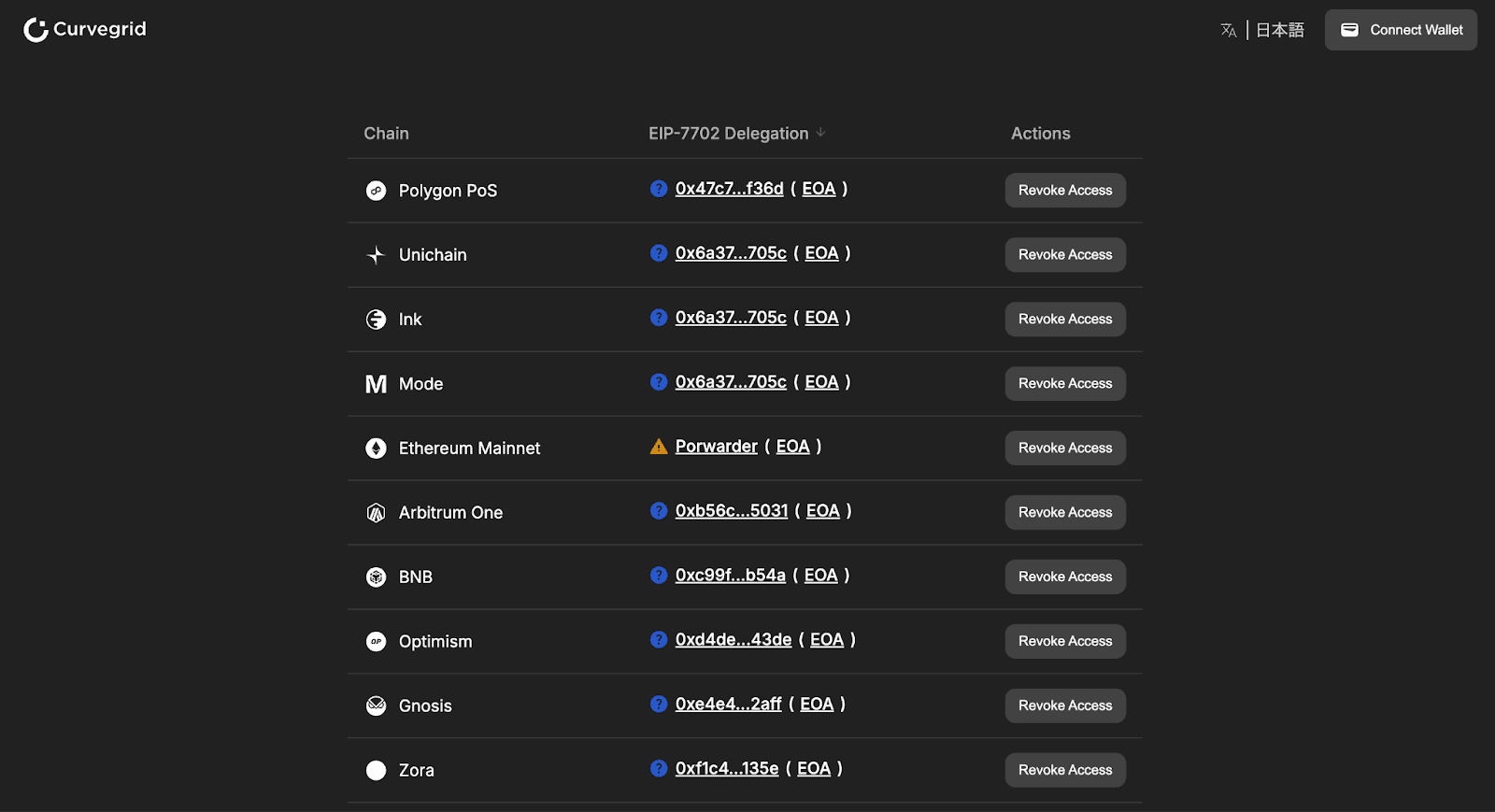
❓ Question mark: The delegate is unknown. This does not automatically mean it is malicious, but it warrants further investigation.
⚠️ Orange triangle: The delegate is associated with known compromised or malicious activity (such as hacker-controlled addresses). This may indicate a potential private key compromise.
These indicators are designed to assist judgment, not replace it.
A compromised wallet may have delegations that appear like this:
Technical Architecture
The app is intentionally built with simple functions:
Frontend-only
Runs entirely in the browser (web UI)
No backend or external dependencies
No wallet data is sent upstream
Queries multiple chains and shows delegation status in one place
Allows users to revoke access on their delegated wallets (support varies across wallet apps)
Source code is fully inspectable
Connecting your wallet is optional, and it simply pulls the active wallet address into the search box. The app is safe, being a simple frontend with inspectable source code. The constrained design is deliberate. Adding history, indexing, or analytics would require backend infrastructure and fundamentally change the scope.
Revocation Remains a Challenge
The checker offers a revoke action, but support for revoking arbitrary delegations is inconsistent and varies by wallet.
Users should ask their wallet providers to add this support, since many wallets do not support the transaction needed to revoke arbitrary EIP-7702 delegations. Unfortunately, users may not be able to revoke if:
The wallet has bugs
The wallet was uninstalled
Support was discontinued
They delegated long ago and forgot which tool was used
This is a real UX gap. Revocation should be a standard wallet safety feature, not a niche developer operation.
Common Misconceptions About EIP-7702
A common misconception is that EIP-7702 is hard to use.
In practice, the protocol is simpler than ERC-4337. What is missing today is tooling that makes delegation, revocation, and edge cases understandable to everyday users.
The most interesting engineering constraint wasn’t performance or scaling, but comprehension.
EIP-7702 is still new enough that:
Documentation is sparse beyond the spec itself
Many posts are high-level
Real edge cases (revocation, authorization signing failures, chain differences) aren’t always spelled out
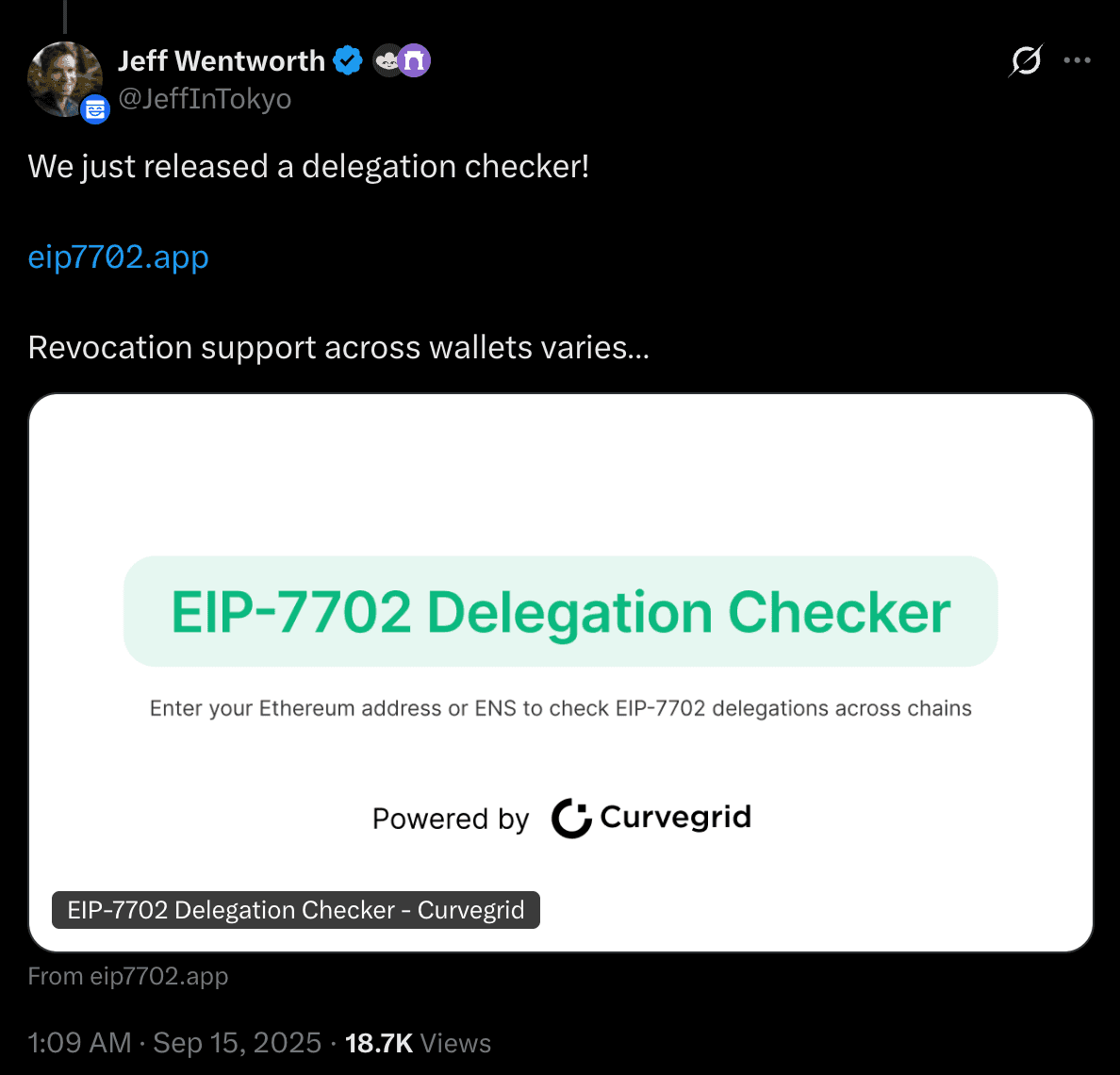
Daily user activity on eip7702.app is a strong signal that EIP-7702 adoption is real and that “visibility tooling” is in demand.
https://x.com/JeffInTokyo/status/1967259513519796358
Important Limitations
It is important to note that the Delegation Checker cannot:
Recover funds after a private key compromise
Guarantee that a delegate contract is safe
Display full historical delegation activity without backend indexing
If you believe your private key is compromised, the correct response is to secure unaffected assets and migrate to a new setup.
What the Ecosystem Needs Next
For protocols building wallets, explorers, or Dapps that involve EIP-7702, consider:
Making delegation visible by default
Making revocation reliable and consistent
For users experimenting with account abstraction:
Periodically check where your address is delegated
Prefer reputable smart wallet implementations
Act quickly if something looks off
And for us at Curvegrid, there are clear directions the checker could evolve in the future:
Improved revocation UX as wallet support matures
Expanded chain coverage
More transparent delegate reputation signals
Optional history mode with clear trade-offs
Even without those expansions, The EIP-7702 Delegation Checker App’s value proposition is evergreen: users want to know what their wallet is “connected to,” across chains, without hassle.