Learning
Stablecoins for Enterprise Treasury: MPC vs Multisig

Stablecoins are moving from crypto-native markets into enterprise finance. In parallel, companies are beginning to evaluate them for common financial workflows like payments, settlement, treasury, and tokenized assets.
For enterprises, a wallet is where digital assets are stored and acts as the control layer for how assets are held, then moved, approved, audited, and eventually deployed across financial workflows. Poor wallet architecture can concentrate authority in one person or device. Strong wallet architecture can support policy-based approvals, role separation, recovery, and auditability.
For finance and operations teams, security is only one consideration. Wallet architecture also determines how approvals are handled, how responsibilities are separated, how transactions are audited, and how digital assets fit into existing treasury processes.
Wallet architecture extends beyond technology. It directly shapes an organization’s governance model, risk posture, and operational controls.
Custodial vs Non-Custodial Wallets
Before stablecoins can become part of everyday business operations, companies need to answer a more basic question: who controls the wallet?
When comparing wallet types, it’s important to first distinguish between custodial and non-custodial (or self-custody) wallets.
Custodial wallets rely on a third party to manage private keys and approve transactions on behalf of the organization
Non-custodial wallets allow the organization to retain direct control over keys, approvals, and governance policies
Single-key, multisig, and MPC wallets can all be implemented using non-custodial models depending on how the infrastructure is designed.
For enterprises, the decision often comes down to balancing simplicity against direct ownership and control. After deciding who ultimately controls the assets, the next step is to understand how control is technically and operationally enforced.
For a deeper explanation, see our guide on custodial vs non-custodial wallets.
Wallet Model Comparisons
Blockchain transactions are generally irreversible, so wallet architecture acts as a preventive control. It determines how authority is distributed before a transaction is approved and submitted to the blockchain. The three main enterprise wallet models to understand are single-key, multisig, and MPC wallets.
Each model takes a different approach to security, control, and scalability.
1. Single-Key Wallets: Fast, But Fragile
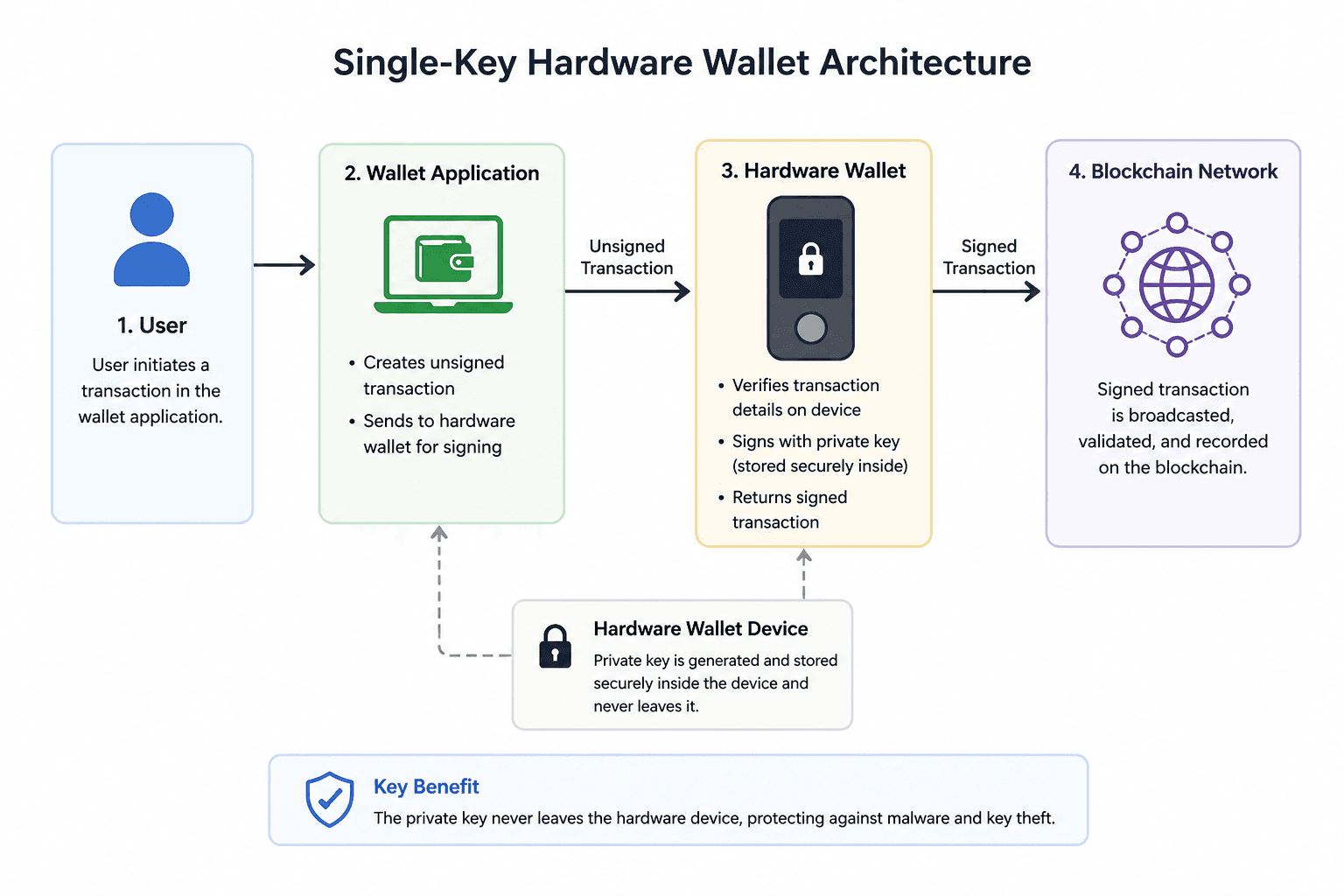
Single-key wallets are the simplest and most widely used wallet model in crypto today. A single-key wallet is controlled by one private key, and whoever controls that key can authorize transactions.
This model is simple, fast, and widely supported. It can work for individual users, prototypes, and low-value testing.
For enterprises, however, the model is fragile. If one person controls the key, that person may effectively control the assets. If the key is lost, stolen, exposed, or mishandled, the company may lose access or suffer unauthorized asset movement.
Examples include:
Software Wallets: Fast, flexible, with higher exposure risk (e.g., MetaMask, Coinbase Wallet, Phantom)
Hardware Wallets: Improved storage security, but slower, more manual, and still dependent on a single key to sign a transaction (e.g., Ledger, Trezor)
Single-key wallets are useful for experimentation, but are rarely the right long-term foundation for enterprise stablecoin operations.


2. Multisig Wallets: Shared Control, With Trade-Offs
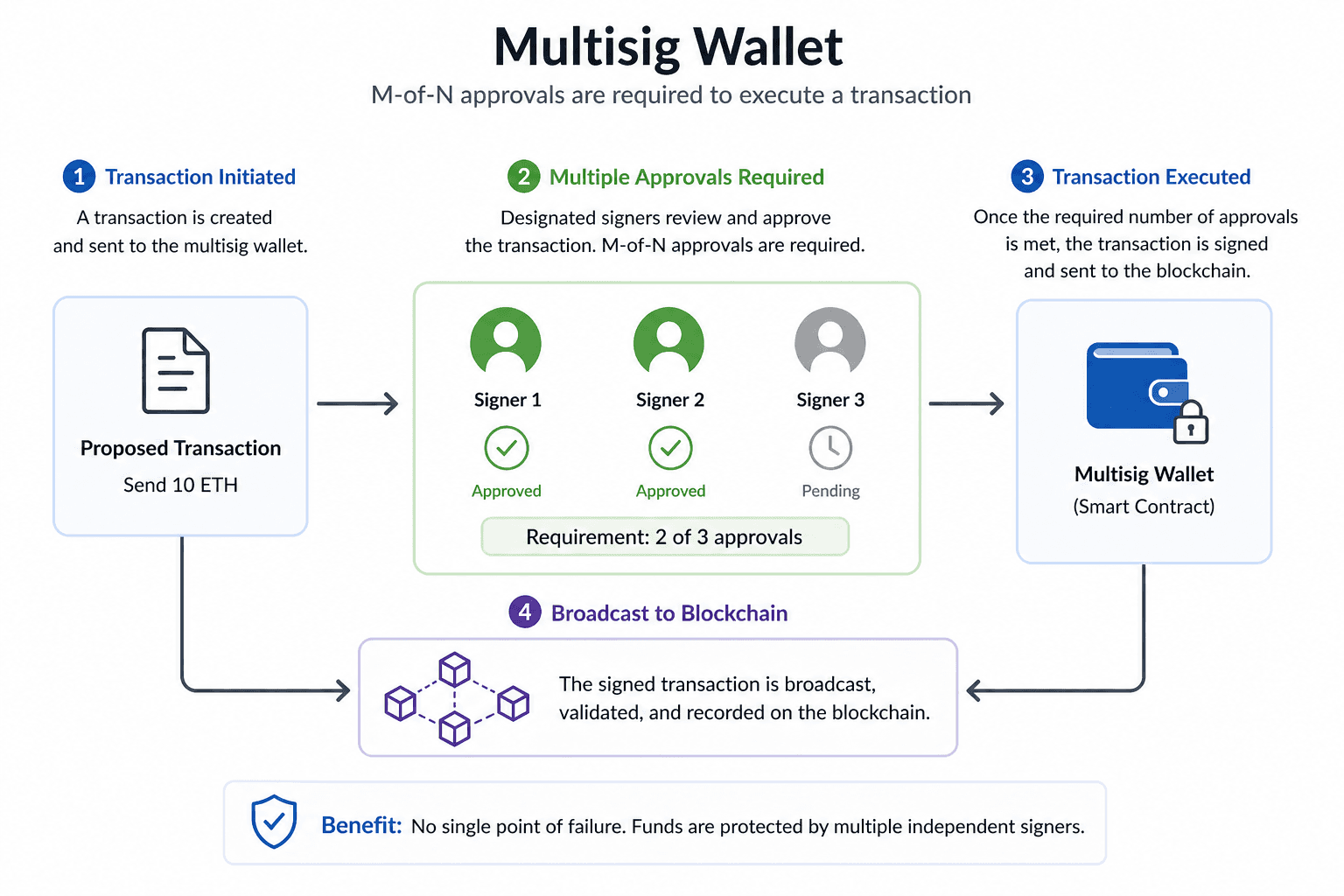
A multisig wallet requires multiple signatures before a transaction can execute. The approval threshold is usually configurable. For example, a 3-of-5 multisig wallet requires any three of five authorized signers to approve a transaction. This reduces reliance on one private key and creates a clearer shared control model.
Multisig can be a strong option for treasury accounts, protocol administration, and shared governance. It is transparent, well understood, and commonly used across crypto-native organizations. Because multisig approval requirements are enforced directly on-chain, the security model is highly transparent. Anyone can verify the signing threshold and transaction approvals from blockchain data. In some scenarios, organizations may prefer this explicit on-chain enforcement over an MPC system that coordinates approvals off-chain.
Multisig wallets come in two varieties: on-chain with native protocol support, and implemented through programmable smart contracts or scripts. Smart contract implementations, such as those used on Ethereum and other EVM compatible chains, can increase transaction size, fee cost, or operational complexity. Other factors include contract risk, upgrade considerations, and integration constraints. The smart contract must be deployed for each chain on which they operate and not all blockchains support smart contracts.
Multisig can also be operationally clunky if approvals are not connected to business workflows. Approvers may need to connect separate wallets, manually inspect transactions, coordinate through external communication tools, or learn blockchain-specific processes.
For some organizations, multisig is a practical starting point. As stablecoin operations scale across entities, teams, assets, and chains, many enterprises may need a more flexible and secure control layer.

3. MPC Wallets: Distributed Control With Enterprise Flexibility
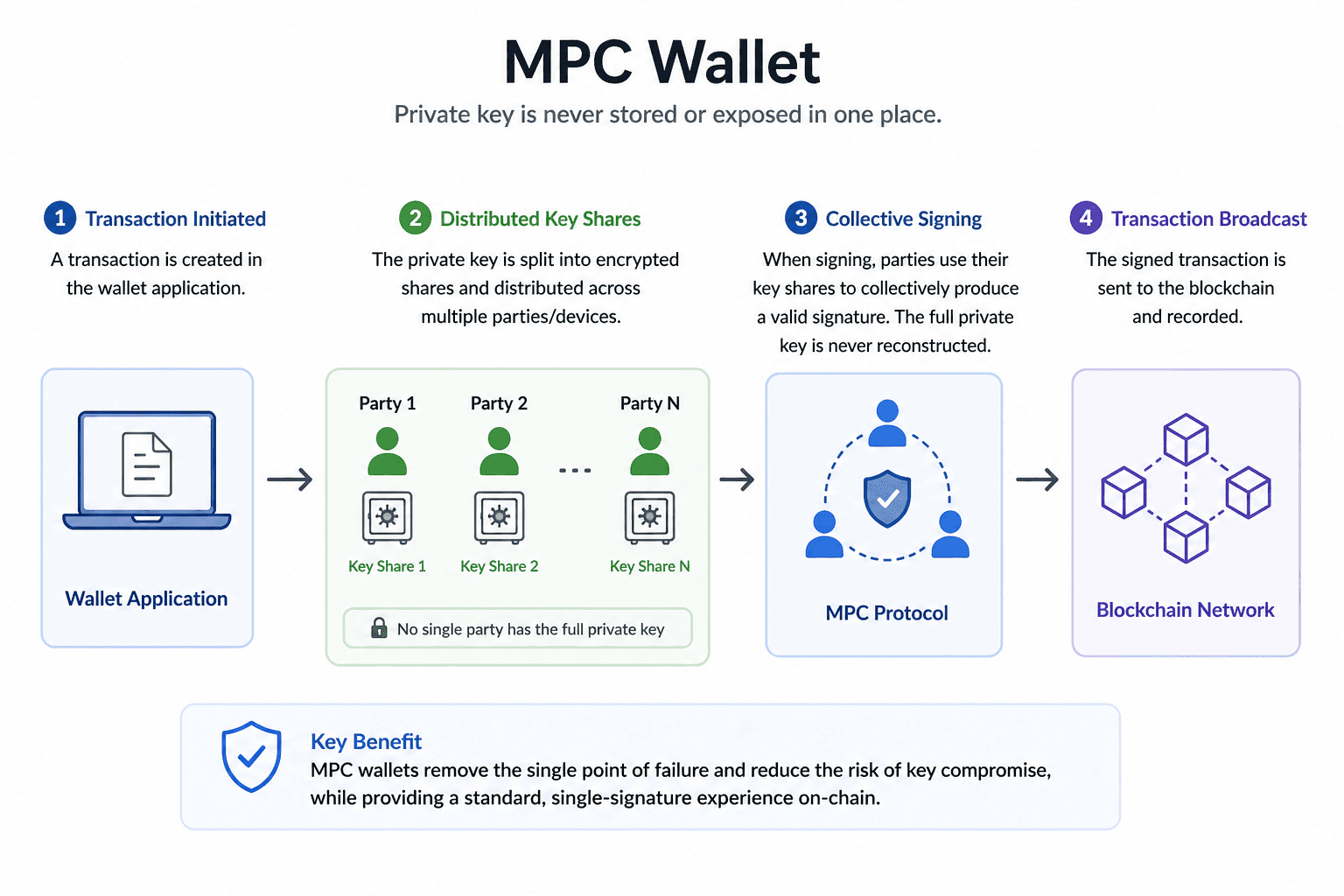
MPC stands for Multi-Party Computation. In wallet infrastructure, MPC wallets typically implement signing via Threshold Signature Schemes, or TSS.
TSS allows multiple parties to jointly produce a standard digital signature without any single party ever holding or reconstructing the full private key. A defined threshold of participants can cooperate to sign, while fewer than that threshold cannot.
On-chain, it will appear the same as a single key account since the multiple approval mechanism is conducted off-chain. This means the account and address can exist without a smart contract deployment.
The security model depends on how key shares are distributed, and who controls them. In many enterprise MPC deployments, both the customer and the provider participate in the signing process. This can reduce reliance on any single person, device, or key, but it also means companies should evaluate the provider’s infrastructure, availability, and recovery procedures.
For enterprise stablecoin operations, MPC’s ability to enforce distributed control behind the scenes while producing a standard on-chain transaction matters in three practical ways.
First, MPC can reduce single-point-of-failure risk. If one device, employee account, server, or credential is compromised, that alone should not be enough to move assets.
Second, MPC can improve compatibility across chains. On Bitcoin, MPC-TSS can avoid some of the transaction size, fee, and script complexity associated with native multisig. On Ethereum and Solana, MPC can avoid some smart contract wallet constraints while remaining compatible with standard account and transaction flows.
Third, MPC allows business approvals to be separated from cryptographic signing.

Multisig and MPC: Similar Goals, Different Architecture
Both multisig and MPC are designed to avoid the risks of a single private key controlling an organization’s assets. The difference is where the approval logic lives.
In a multisig wallet, approval requirements are enforced on-chain, usually through a smart contract wallet. The contract or protocol ensures that the required number of signatures have been provided before a transaction executes.
In an MPC wallet, approval and signing are coordinated off-chain among multiple participants (server-side and signer-side). The blockchain ultimately sees a standard transaction signed by a single cryptographic key, even though no participant ever possesses the full key.
In practice, many organizations may use both approaches. A treasury reserve wallet may use a multisig structure with highly visible governance controls, while day-to-day operational wallets may use MPC-based workflows that integrate more easily with internal approval systems.
Both approaches distribute authority, but have different tradeoffs when it comes to transparency, compatibility, flexibility, and trust assumptions.
Why MPC Fits Enterprise Stablecoin Operations
Stablecoin use cases are not limited to simple transfers. A company may start by holding stablecoins for settlement or treasury diversification, then expand into vendor payments, intercompany transfers, cross-border settlement, tokenized assets, staking, institutional lending, liquidity provisioning, or other approved financial activities.
As these use cases grow, the wallet needs to do more than hold assets safely or move them efficiently. It needs to enforce control across different activities: who can deploy assets, under what conditions, within which limits, and with what evidence for internal review. This is where MPC-based wallet infrastructure can be useful. By combining distributed signing authority with flexible policy controls and broad blockchain compatibility, MPC wallet systems can help finance, operations, and compliance teams manage different assets, entities, chains, and financial instruments through a common control layer.
For example, a company could apply different approval policies for stablecoin payments, transfers between internal wallets, large transactions, new wallet addresses, staking activity, lending activity, liquidity provisioning, or withdrawals from approved platforms. The goal is to ensure that as digital asset use cases expand, those activities can be governed with the same discipline applied to treasury, payments, and financial controls.
MPC is powerful, but it still needs thoughtful implementation. Different MPC providers may vary significantly in how they handle recovery, policy enforcement, user permissions, integrations, audit evidence, and operational controls. For enterprises, MPC is most compelling when its cryptographic security is paired with practical controls for managing digital assets day to day.
Where Curvegrid Fits
Curvegrid helps enterprises design and operate digital asset infrastructure that maps to real business workflows.
For teams evaluating stablecoins, the challenge, besides choosing between single-key, multisig, and MPC wallets, is designing the governance layer around digital asset operations.
That includes:
role-based permissions,
transaction approval policies,
spending limits,
entity-specific controls,
audit-ready logs,
recovery procedures,
and integration with blockchain applications and enterprise systems.
Curvegrid’s MultiBaas developer platform helps engineering teams integrate blockchain workflows through APIs and enterprise tooling, reducing the need to build core infrastructure from scratch. For organizations using multisig, MultiBaas can help integrate Safe multisig workflows into applications and operational processes.
Curvegrid is building next-generation infrastructure for enterprises to manage and operate digital assets with MPC-based custody, role-based controls, multi-entity treasury workflows, and audit-ready approvals.
We help organizations safely hold, move, govern, and deploy digital assets with the same rigor applied to treasury, compliance, and financial controls.
Conclusion
Stablecoin adoption depends on more than asset availability or regulatory clarity. Companies also need infrastructure that can support safe, controlled, and auditable operations. Single-key wallets may be useful for experimentation, and multisig can provide shared control, but MPC offers a strong foundation for enterprises that need distributed signing authority, broad chain compatibility, and flexible policy controls.
More importantly, wallet infrastructure should help companies hold and manage digital assets as part of a broader treasury and operations strategy.
If your team is evaluating stablecoins, MPC, multisig, custodial, or non-custodial wallet infrastructure, Curvegrid can help map the right architecture to your approval flows, treasury controls, audit requirements, asset deployment strategy, and integration needs.
Book a consultation to explore the right wallet operating model for your organization.
FAQ
What is an MPC wallet?
An MPC (Multi-Party Computation) wallet is a wallet where the private key is never created or stored in one place. Instead, it is split into encrypted shares held by different parties, and transactions are signed collaboratively using a cryptographic protocol. This approach reduces the risk of key exposure while maintaining a standard, single-signature experience on-chain, making it well-suited for enterprise custody and control.
What is a multi-signature wallet?
A multi-signature (multisig) wallet requires cryptographic signatures (approvals) from multiple parties before a transaction can be executed. Instead of relying on a single private key, control is distributed across several keyholders (for example, 2-of-3 or 3-of-5). This reduces the risk of a single point of failure and enables shared governance, making multisig a common choice for treasury management and protocol administration.